Blog

  • About me being a part of the Advance Team

    About me being a part of the Advance Team

    Lyrical digression:


    On March 8, at the Embassy of the Kingdom of Thailand, sometime around… hmm… 2011.

    The speech was delivered by Ms. Passporn Sangasubana, who was Head of the Chancery at the time. I worked in the same office as her o_0, while my own desk was occupied by a student intern training to be an assistant in the Consular Section. Vasily, the Thai interpreter on the video, was shocked that I was given such an honor)) Like, for diplomats, local staff are just… little piggies and pawns))

    But it gets better — out of all the staff and the members of the Advance Team for the visit of HRH Princess Chulabhorn Mahidol of Thailand, I alone was invited to greet Her Royal Highness in the lobby of the Baltschug Kempinski hotel (which, according to a Thai colleague, was then partly owned by the Adulyadej royal family). The emotions when the cortege arrived, escorted by security service cars with sirens (not the “little blue buckets” on the roof), were indescribable. It took my breath away! I still remember how the princess, who had difficulty moving due to an injury, carefully looked over everyone making a curtsy (the hotel staff refused, saying — we’re Russian, she’s not our princess and it’s not our tradition), and me among them.

    And also, two hours before the princess’s meeting with V.V. Putin, Consul Najsiri (I can’t even remember her surname now), gushing, declared: “Khun Yulia, why don’t you go with us to Mr. Putin? You won’t need an interpreter, our diplomat will be acting in the capacity of an interpreter. You’ll just sit and watch!”

    My jaw dropped. I wasn’t expecting an offer like that. But, of course, and to my regret, the Protocol Service of the Kremlin Administration laughed at the consul’s suggestion — like, such matters aren’t arranged two hours before a meeting (understandably, they require a thorough vetting)))

    But when the cortege arrived at the Kremlin for the tour of the Diamond Fund and the Armoury Chamber, my documents passed the security service check. So I’m on the Kremlin’s radar, or, at least, I guess so…

    If only you knew what stress I went through when I was asked to change the cortege cars a day before the tour and to coordinate it with the Kremlin Protocol Service. Their staff member snapped at me, yelling that such things are coordinated MONTHS in advance, not a couple of days. To which I replied: “Well, you do understand, this isn’t my initiative, I’m just calling at the diplomats’ request…”

    Okay, it was coordinated. I burst into tears… Ms. Sangasubana comforted me, saying, you’re doing everything right, you work for the government of Thailand, not for the Kremlin. Made my day!)))

    #ThaiWaiSmile

  • The day I became the face of Thailand in St. Petersburg

    One of the most memorable moments of my time at the embassy came during Thailand Culture Day in St. Petersburg.

    To my surprise, the Thai diplomats chose me, a Russian member of the local staff, to host the concert and conduct the cultural quiz on stage.

    I was not simply going to introduce the performers.

    I was going to represent Thailand in front of the audience.

    And there was one small problem.

    I was Russian.

    The solution was spectacular.

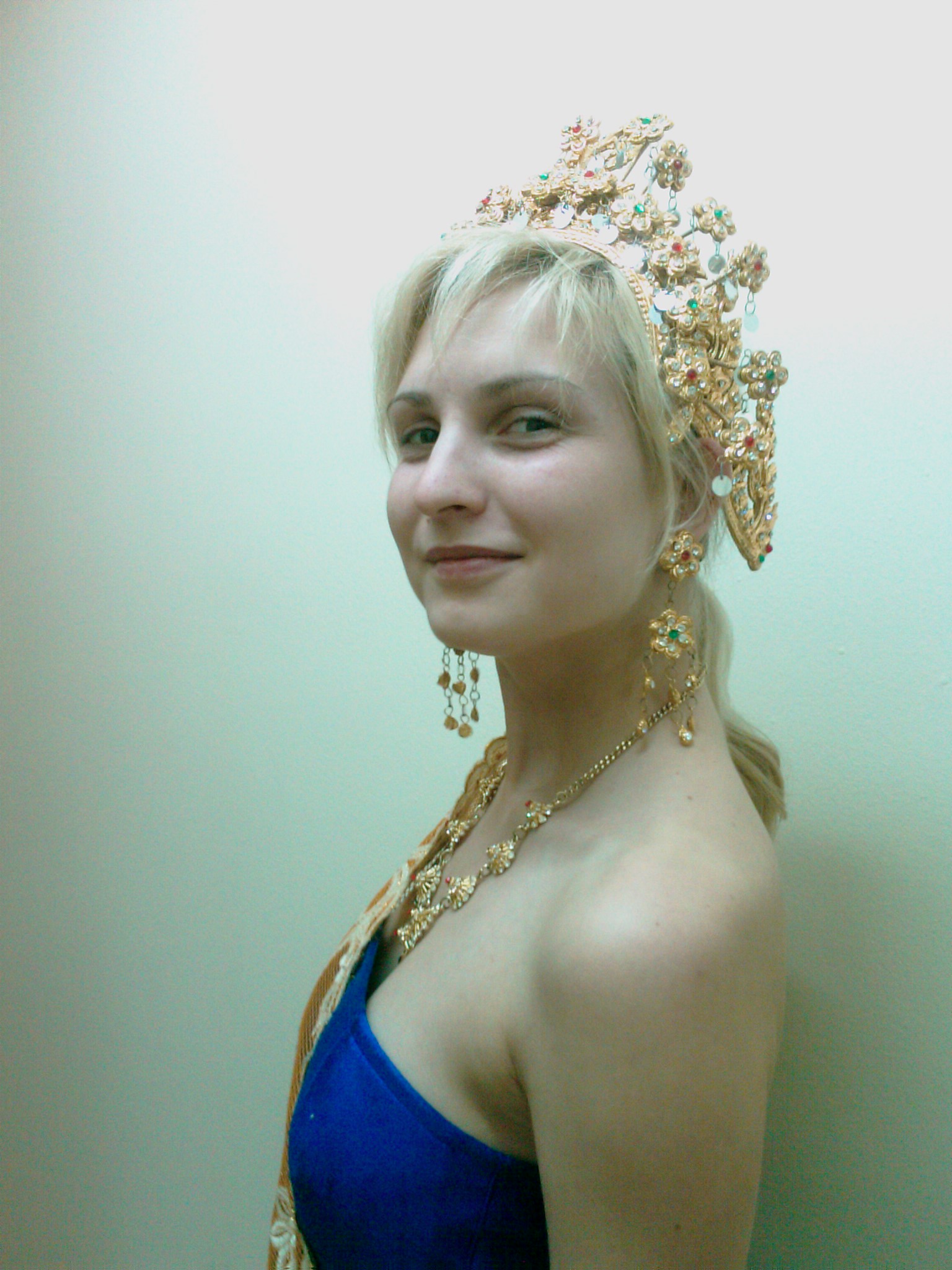
    For the occasion, I was dressed in traditional Thai clothing: deep royal-blue silk, a golden sabai embroidered with delicate floral patterns, pearls and sequins, and a traditional golden hairpin holding my hair in a sleek bun.

    The transformation was astonishing.

    But the clothes were only part of it.

    I had also learned how to move.

    When I greeted people, my hands naturally followed the gestures I had absorbed from watching Thai colleagues. I used the wai when appropriate and paid attention to the way the hands, posture and movement changed according to the situation.

    I was not trying to imitate a Thai woman.

    I was trying to show respect for something that mattered enormously to the people I was representing.

    And somehow, it worked.

    The audience watched a Russian woman speaking English, wearing Thai dress and moving with what they perceived as genuine Thai grace.

    After the performance, one of the guests came up to me.

    She looked at me carefully and asked:

    “Are you Thai?”

    I smiled.

    “No. I’m 100 percent Russian.”

    “You should have said you were half-Thai!”

    The next morning, something happened that I remember to this day.

    Ambassador Chademron Tanchitt and his wife, Madame Sutida, invited me to join them for breakfast.

    It was a surprisingly personal gesture in an environment where protocol and hierarchy mattered enormously.

    Naturally, I told them about the question I had been asked after the performance.

    The Ambassador laughed.

    Then, with a mischievous smile, he told me:

    “You should have said you were half-Thai!”

    I laughed too.

    But there was something behind the joke.

    In Thailand, people of mixed Thai and foreign heritage — often referred to as luk khrueng — have long had a particular place in popular culture and public life. They can be admired for combining different cultural worlds.

    And perhaps that was what the Ambassador was really telling me.

    Although I am Russian (however, a half-breed one, Russian/Belarussian 50/50), but for a few hours on that stage, I had managed to put on a different identity, similar to Jason Borne.

    I had not become Thai.

    I had simply learned how to “Keep up apperances’ 😉

  • Thai Diplomats Thought I Secretly understood Thai language

    For years, I worked at the Royal Thai Embassy in Russia. Looking back, what fascinates me in my reminiscing the most is not the ceremonies, the silk dresses, the gold ornaments or the grand diplomatic receptions. It is something much harder to explain.

    I never spoke Thai. And yet, at one point, one of the Thai diplomats (namely, the Consul) became convinced that I did. She was not entirely wrong. I could understand something — just not the words.

    I had learned to read the pauses, the expressions, the gestures, the hierarchy, the intonation (I could easily grasp whether the speaker is amused/joking/serious/angry/commanding or upset or comforting, by “reading” – I mean, listening and catching the intonation).

    I would be able to do that not visually (receiving and analyzing nonverbal communication: mimics and gestures). I would almost always get the gist of what being said even if the speaker (the Thai diplomat) was in another office room. That was my first real lesson in what I now think of as the Thai way.

    Being the host of Thailand Days in St. Petersburg and being taken for a Thai national

    One of the most memorable moments of my time at the embassy was designating me as the host Thailand Culture Days in St. Petersburg. As I was the Assistant to the Public Relations Department of the Embassy, my boss chose me, a Russian member of the local staff, to host the concert and conduct the cultural quiz on stage.

    I was not simply going to introduce the performers – tradional Thai dancers in the national apparel. I was going to represent Thailand in front of the audience. And there was one small problem. I was Russian with a Slavic appearance.

    The solution came as a workaround. For the occasion, I was dressed in traditional Thai clothing: deep royal-blue silk, a golden sabai embroidered with delicate floral patterns, pearls and sequins, and a traditional golden hairpin holding my hair in a sleek bun.

    The transformation was astonishing for me. I absolutely loved the look. The only thing I refused was the fake eye lashes. I gently turned down the makeup artist proposal, as I said I would prefer to for a natural look (natural Thai loo for a Russian girl, ahhaha!).

    But the clothes were only part of it. I had also learned the Thai gestures on my first days of working at the Embassy. When I greeted diplomats on auscpicious occasions, my hands naturally followed the gestures I had absorbed from watching Thai colleagues. I wouldn’t call it copycatting/monkey see – monkey doing or mimicing. I’d rather refer to it as rescpecting the cultural code and showing this respect to the interlocutiors.

    I used the wai greeting sign when it was due and paid attention to the way the hands, posture and movement changed according to the situation. I was not trying to imitate a Thai woman. I was trying to show respect for something that mattered enormously to the people I was representing.

    And somehow, it worked at the festival in Sankt-Petersburg. The audience watched a Russian woman speaking Russian, wearing Thai dress and, at the same time? moving with what they perceived as a genuine Thai way (or so I think because of the question I was asked after the show). After the performance, one of the guests came up to me. He looked at me carefully and asked: “Are you Thai?”

    I smiled. “No. I’m 100 percent Russian.”

    “You should have said you were a half-breed!”

    The next morning, the outcome of this mistaken identification of the event guest had a continuation. His Excellency the Ambassador Extraordinary and Plenipotentiary Mr. Chalrmpol Thanchitt and his wife, Madame Sutida, invited me to join them for breakfast at the hotel dining hall, the VIP section. It was a surprisingly kind gesture in an environment where protocol and hierarchy mattered as they always do.

    During breakfast and the small talk (discussing the yesterday’s festival), I told them about the remarkable question I had been asked after the performance, whether I was Thai. The Ambassador laughed his heart out. Then, with the traditional Thai smile, he told me: “You should have said you were a half-breed.”

    I laughed too. But there was something behind the joke. I am indeed a half-breed: half-Russian and half-Belarusian. With the Thainess that people as well as the Thai diplomats acknowledges in me, I guess I am multi-culti, as the Dutch say.

    “My heart is in Highlands, my heart is no here!”

    I guess, as the posters in Amsterdam say (where I lived and work for about 3 years): Your home is where your heart is.

    So… Let me introduce myself: Yulia Martsul, being indentified as a Jason Borne’s partner in…multiple identities 😉

  • My first job interview: How, beyond my own expectations, I landed a job at a Royal Thai Embassy


    Having graduated from Ryazan State University in 2009 with a BA cum laude in Linguistics and Intercultural Communication (plus a BA in Economics, so I hold two diplomas), and after analyzing the local job market, I decided to try my luck in Moscow. As the capital was the main employment hub, I often received interview invitations, and I came to realize that it would be more efficient and more budget-friendly to move to the capital (200 km from my hometown) and rent a flat there, rather than traveling back and forth for interviews.

    Pretty soon, I got a job as an English language teacher at a private language school. My students were initially a teenager and a child, but just a few weeks after my first lesson, I was assigned to teach adults, namely bankers and IT specialists. I also gave lessons to two CEOs of large Russian corporations.

    The job was rewarding; it brought me joy to see my students’ progress. However, I felt that teaching was not my vocation, and I kept looking for other opportunities. And one day, around the end of November, on a headhunting website, I saw a vacancy for a Translator/Interpreter at the Royal Thai Embassy. Without giving it a second thought, I immediately applied.

    I arrived a bit late and apologized, calling the administrator at the reception. She reassured me that it was fine, as there was a queue of other candidates. Interestingly reassuring.

    There were many young women in the hall outside the meeting room. I remember it clearly: I sat down on a chair in the far right corner, looking from the perspective of the meeting room exit. I took a critical look at what the other girls were wearing and noticed that some of their outfits weren’t quite right for an interview of this level—their style was casual and not formal enough—which made me wonder how I looked myself. When I was called into the room, I was directed to sit across from the diplomats at a long table. If I remember correctly, there were five diplomats in total, and we exchanged radiant, polite smiles. They asked me about my current job, and I told them that I teach English and enjoy it, though I was never formally trained as a teacher—and the diplomats nodded politely and understandingly with a smile (oh, that magical Thai smile). I told them about my internship and mentioned that I had done translations for the customs service (specifically for their public relations department). They asked if I had ever been to Eastern or Asian countries, and I replied that I hadn’t yet, only to Turkey. The sight translation wasn’t difficult; the text was about a cultural event, and I had to translate it from Russian into English.

    The next task was a written translation, from English into Russian, of some sort of political event. There were several English words I wasn’t sure how to translate into Russian. “Come what may” and “So be it!” — were my thoughts, and I used a dictionary on my smartphone to check the translations of the words in question. A few minutes after I started writing my translation, one of the diplomats (I later learned it was the Consul), passing by one of the candidates who was also doing the test translation, politely said: “Sorry, but your time is up,” to which the girl simply replied: “I know,” and continued writing the task.

    I numbered all the pages of my translation, thinking that this way I would demonstrate attention to detail and care for the person who would check my work. I also folded the sheets to show my neatness.

    A few days later, I received an invitation to work. I was head over heels!

    The Chancellor said the salary would not be very high; here we (they also hired one translator and one administrator) would work for a foreign governmental organization, and we would work on our resume ( meaning, this work experience will add a great value to our CV’s). That was bespoken truth.